
 Facebook Ads
 TikTok Ads
 Shopify
Black Friday 2025: RON 10.89M in Shopify sales in 30 days
A Romanian premium furniture brand recorded 10.89 million RON in total sales and 3,627 orders in Shopify in November 2025. Separately, Meta Ads reported ROAS of 24.83xwithin a system built for sustained traction, not a single promotional peak. The brand's name is not public for contractual reasons. All data is verifiable in the platform.



Premium furniture brand. Own manufacturing. Shopify Plus and Meta Ads.
The client is a premium furniture brand in Romania that manufactures its own corner sofas, sofas and upholstered beds. Products are made locally, positioned in the premium segment and sold through two complementary channels: a Shopify Plus online store and physical showrooms.
The business model is omnichannel: the website and showrooms support each other. Meta Ads campaigns generate qualified website traffic, but also indirectly bring visitors into showrooms: people who discovered the brand online, researched for weeks and choose to see the finishes in person before making their final decision. From 2026, showroom orders are entered as drafts in Shopify, which will allow accurate measurement of the real contribution.
Category context matters: premium furniture has a long decision cycle, with weeks or months before an order. The average AOV of 2,790 RON reflects both product positioning and the maturity of the brand's audience relationship. A returning customer rate of 13.3% in an infrequent-purchase category is a solid indicator.
How to scale a high-ticket brand in the most competitive month of the year.
Black Friday is the month with the highest competition and traffic acquisition costs in the annual e-commerce calendar. CPMs rise significantly, audiences are bombarded with offers and attention is more fragmented than ever. In a category with a long decision cycle, the pressure intensifies.
Business objectives for November 2025 targeted two simultaneous, seemingly contradictory directions: maximum sales volume during the Black Friday window and maintaining efficiency across the campaign system throughout the month, not only on peak days. Increasing Meta Ads budget with a dramatic ROAS decline was not an option.
Specific challenges
- Scaling Meta Ads budget without degrading ROAS during peak competition
- Sustaining traction for 30 days, not just around the traditional BF dates (28–29 November)
- Coordinating the offer launch with the brand ambassador for maximum impact at campaign opening
- Managing 3,627 orders in a made-to-order production model, rather than from predefined stock
- Maintaining high AOV despite significant discounts
The Meta Ads strategy that delivered. The logic behind the decisions.
The November 2025 strategy did not start in November. The [ALS] campaign system was built and calibrated throughout the year, with continuous optimization over summer when competition is lower and CPM allows efficient testing. Black Friday was the execution of an already mature system, not an experiment.
Meta Ads Campaign structure and the [ALS] system
The entire campaign architecture ran within a productized system known internally as [ALS]. The structure defines campaign types, budgeting logic, scaling rules and stopping criteria. Campaigns were not rebuilt for BF: they entered November with accumulated data, warm audiences and a solid optimization history.
The first two campaigns, active throughout the month, together generated 1,453 of the 2,943 purchases attributed by Meta (49% of the total), at ROAS of 29.14x and 29.60x respectively.
Advantage+ Automation with strategic control
Advantage+ campaigns used the behavioral signals accumulated in the account. Instead of defining manual audiences for each campaign, the system let Meta's algorithm optimize budget distribution between segments.
The practical BF advantage: Advantage+ adapts in real time to changes in user behavior. In November, these changes are fast and unpredictable. A manual system would have reacted later.
Catalog Ads Dynamic Product Ads and an optimized feed
DPAs ran throughout the month with a feed updated in real time to reflect availability and promotional prices. Combined targeting covered retargeting audiences (recent visitors, ATC, initiated checkout) and prospecting through similar audiences.
Feed quality played a critical role: optimized titles, high-resolution images, updated prices and promotional labels visible directly in the ad. A poor feed during BF means higher CPM and lower CTR.
Retargeting Warm audience. Right moment.
The long decision cycle means there was a substantial warm audience entering November: people who had visited the website in the previous 30, 60 or 180 days but had not bought. This audience represents expressed intent, not surface-level interest.
- 30-day retargeting: the warmest segment, highest budget priority
- 180-day retargeting: a broader segment, reactivation messaging with the BF offer
- ATC and abandoned checkout: the shortest conversion cycle, dedicated allocation
Creative Brand ambassador and a concrete offer
The Black Friday offer launched in coordination with the brand ambassador, adding credibility and extra organic reach at the moment paid distribution activated. The central message was simple: 50% off selected products, plus an extra 5% when paying by card.
- Video ads with the brand ambassador: maximum reach, premium association
- Static catalog with visible promotional pricing: direct conversion
- UGC and authentic content: credibility and low CPC
The offer Promotional mechanics with a real incentive
Not every discount works for premium furniture. A discount perceived as artificial, from an artificially inflated price, erodes buyer trust. The November 2025 offer was designed to be perceived as real and time-limited.
The combination of 50% off + an extra 5% when paying by card created two layers of motivation: a substantial product discount and an additional payment-method benefit. This structure maximized both conversion rate and average order value.
Shopify Plus Technical infrastructure for volume
Processing 3,627 orders in a single month under a made-to-order model requires stable technical infrastructure. Shopify Plus handled traffic peaks without performance problems: nonnegotiable in a window where every second of latency reduces conversion rate.
Meta Ads results verifiable in the platform. Screenshot by screenshot.
The proprietary [ALS] system ran without major architectural changes throughout the month: scaling on a previously calibrated system, not emergency reconfiguration for the peak.
Attribution note. Meta attribution (7 days after click, 1 day after view) records sales where the platform was present in the conversion window, not necessarily as the sole source. In furniture, with decision cycles lasting weeks and several channels active simultaneously (Google, email, direct, brand ambassador), some Meta-attributed sales may reflect the combined contribution of the entire marketing ecosystem. The figures are real and verifiable.
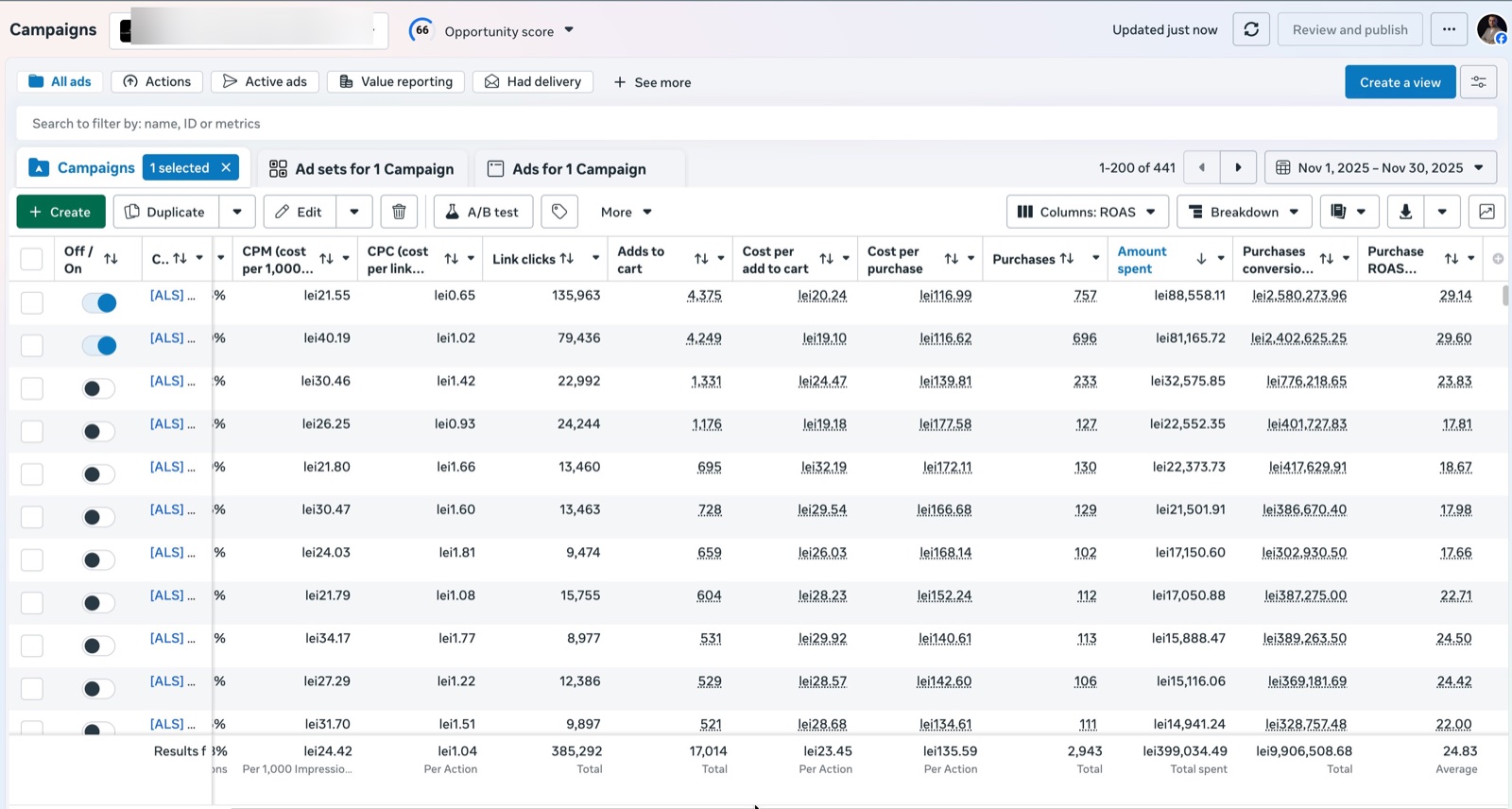
[ALS] system · budget 399,034 RON · 2,943 orders · purchase value 9,906,508 RON · average ROAS 24.83x. CPM 24.42 RON · CPC 1.04 RON · 385,292 link clicks · 17,014 ATC. The brand is not public for contractual reasons; figures are extracted directly from the platform.
Breakdown by main campaigns
| Campaign | Spend | Purchases | ROAS |
|---|---|---|---|
[ALS] Campaign 1 · active all month CPM 21.55 RON · CPC 0.65 RON · 135,963 clicks · 4,375 ATC |
88,558 RON | 757 | 29.14x |
[ALS] Campaign 2 · active all month CPM 40.19 RON · CPC 1.02 RON · 79,436 clicks · 4,249 ATC |
81,165 RON | 696 | 29.60x |
[ALS] Campaign 3 · tactical window CPM 30.46 RON · CPC 1.42 RON · 22,992 clicks · 1,331 ATC |
32,575 RON | 233 | 23.83x |
[ALS] Campaign 4 · tactical window CPM 26.25 RON · CPC 0.93 RON · 24,244 clicks · 1,176 ATC |
22,552 RON | 127 | 17.81x |
Total [ALS] system · 1–30 November Average CPM 24.42 RON · average CPC 1.04 RON |
399,034 RON | 2,943 | 24.83x |
Shopify revenue confirmed by the store. Independent of Meta Ads attribution.
Shopify records all transactions, regardless of traffic source. The 10.89 million RON total includes contributions from Meta Ads, Google Ads, direct traffic, organic and the other active channels. It is the store's actual sales figure for the month.
Shopify total sales grew 237% compared with 2–31 October 2025. The comparison includes every store channel and the offers active during Black Friday.
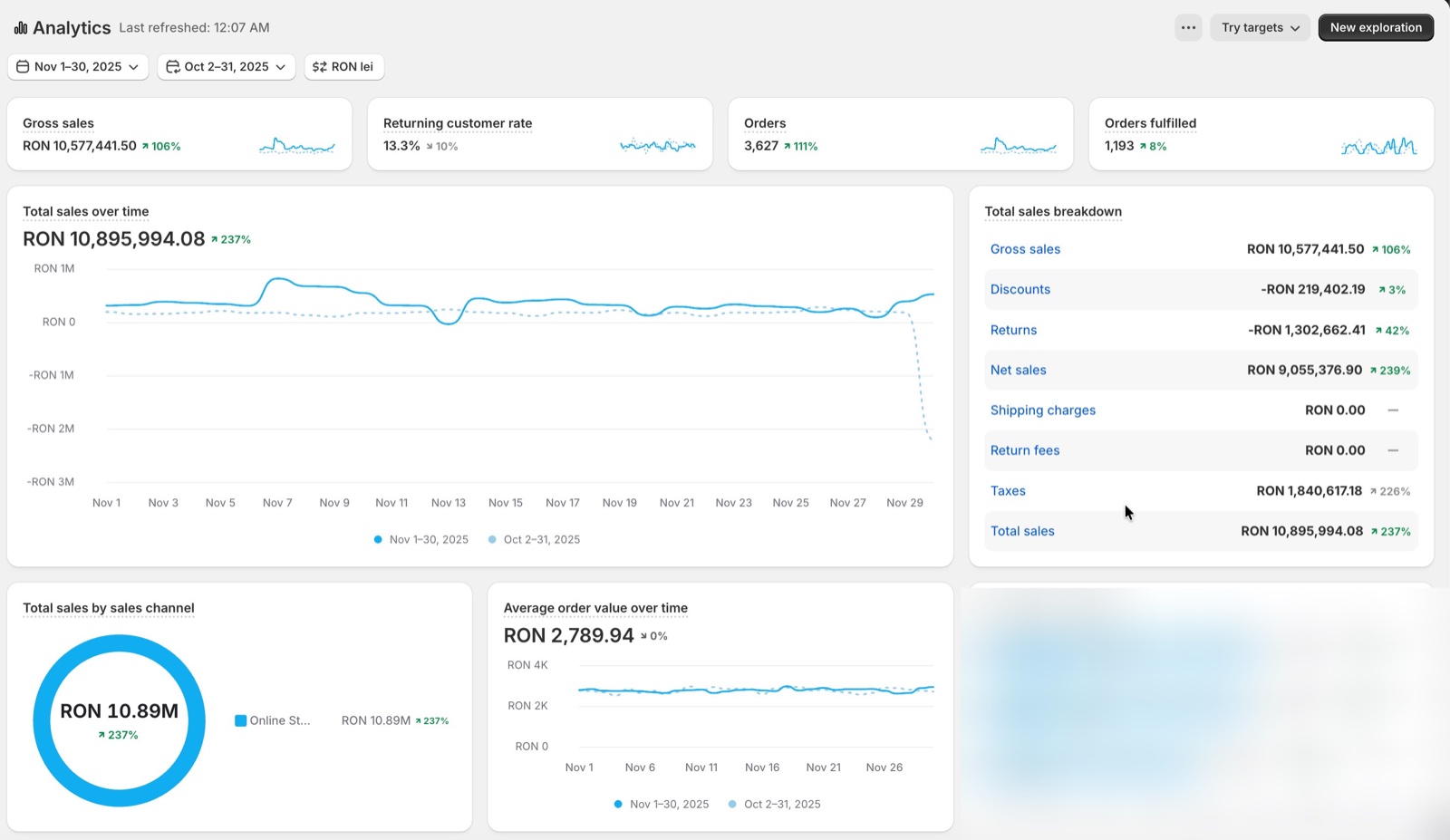
Total sales 10,895,994 RON (+237%) · Gross sales 10,577,441 RON · Net sales 9,055,376 RON (+239%) · Orders 3,627 (+111%) · AOV 2,790 RON · Returning rate 13.3%. All channels included. Figure verified directly in Shopify.
826,000 RON in one day. 254 orders. Average ROAS 40.33x.
The month's peak did not fall on 28 or 29 November, the traditional Black Friday dates. It fell on 7 Novemberin the campaign's first week. This reflects the behavior of premium furniture buyers: they do not wait for arbitrary dates. When conditions were right, with a substantial offer credibly launched by the brand ambassador and communicated through Meta Ads to warm audiences, the decision came immediately.
On Meta Ads: 218 purchases in 24 hours, 18,116 RON spent, purchase value 730,584 RON, average daily ROAS 40.33x. The most efficient campaign reached ROAS of 57.42x: 1,970 RON budget generated 113,157 RON in revenue. After that day, the brand continued generating high sales through month-end without a post-peak collapse.
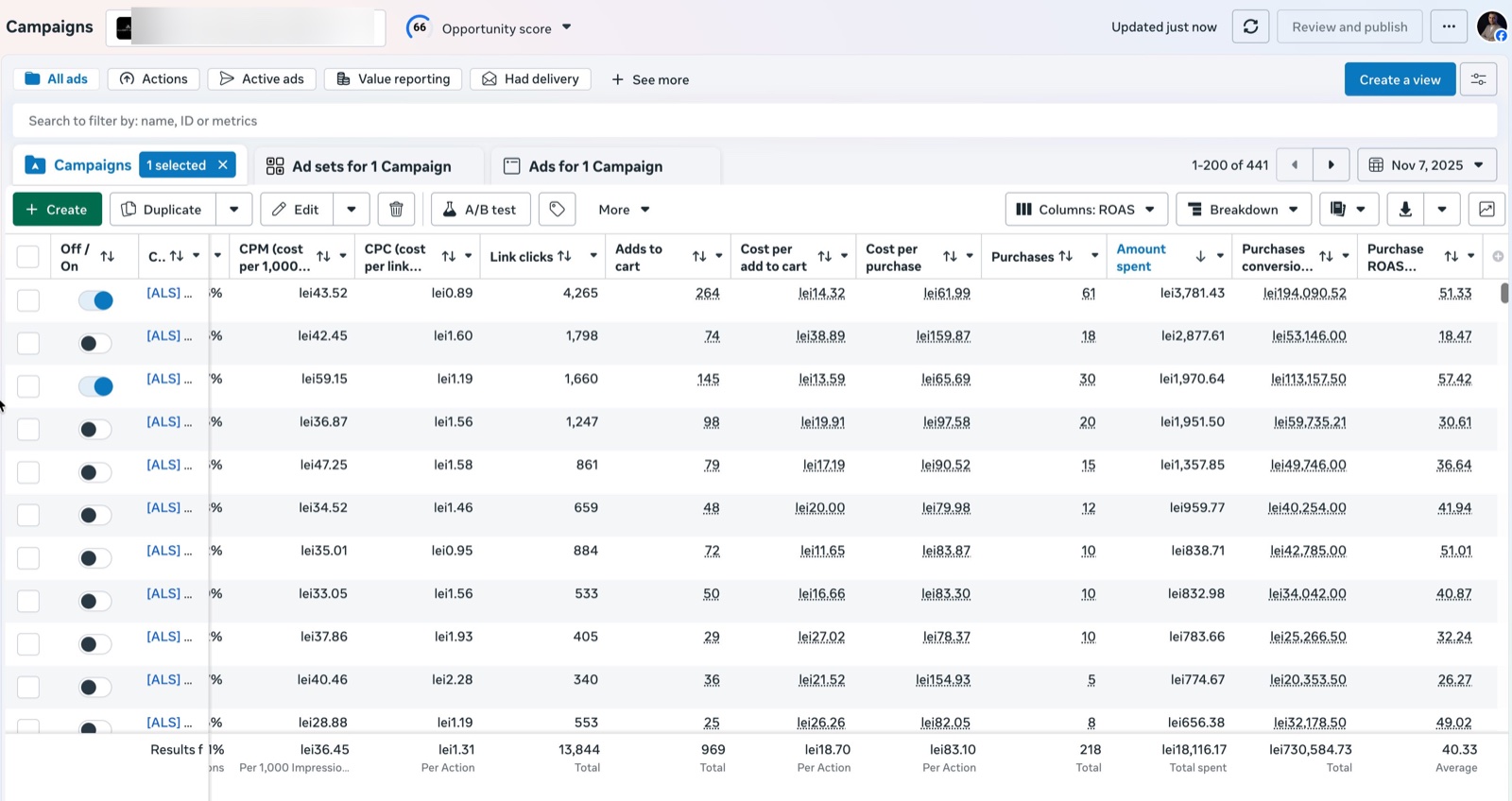
7 November · budget 18,116 RON · 218 attributed orders · purchase value 730,584 RON · average daily ROAS 40.33x. Campaign 1: 3,781 RON → 61 orders → 194,090 RON → ROAS 51.33x. Campaign 3: 1,970 RON → 30 orders → 113,157 RON → ROAS 57.42x.
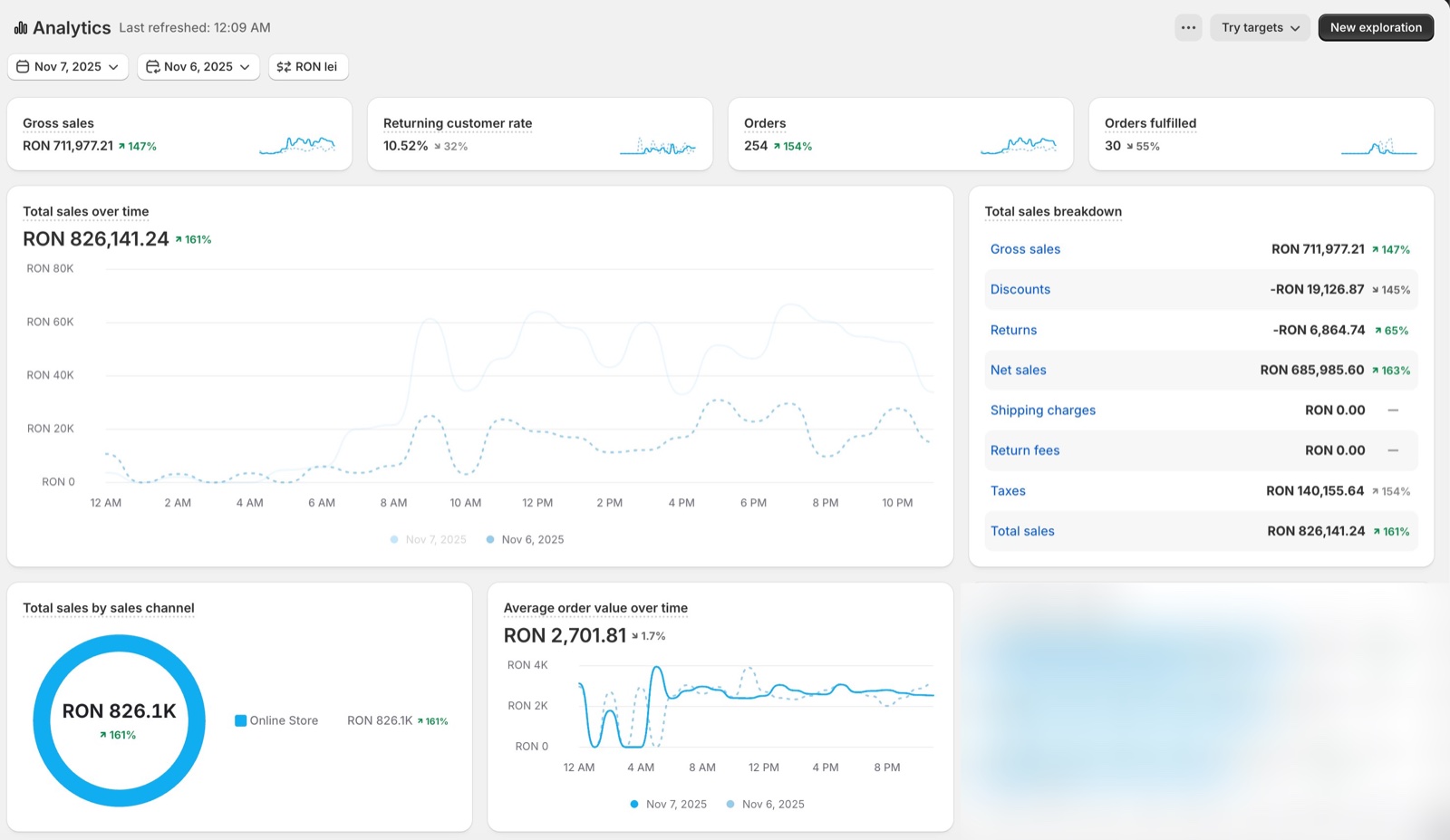
7 November · Total sales 826,141 RON (+161%) · Gross sales 711,977 RON (+147%) · Net sales 685,985 RON (+163%) · Orders 254 (+154%) · AOV 2,701 RON. Shopify independently confirms the conversion, not just the click.
Why this result matters. Numbers in real context.
Case study figures make sense only in context. ROAS of 24.83x may seem spectacular or modest depending on the product category, attribution model and cost structure. This section explains why the results matter, without hype or false comparisons.
Why ROAS of 24.83x matters
Meta reported 9,906,508.68 RON in attributed value on 399,034.49 RON spent, or ROAS of 24.83x. For commercial decisions, we read Shopify sales, product costs, discounts, returns and operating costs separately.
Why AOV of 2,790 RON matters
A high AOV means each conversion generates more revenue, reducing volume pressure. A store with an AOV of 200 RON needs 13.9 times as many orders as one with an AOV of 2,790 RON for the same total revenue. Maintaining AOV at 2,790 RON in a month with 50% discounts is notable: it means accelerating decisions on high-value products, not simply attracting budget buyers.
Why a 399,000 RON budget matters
The November Meta Ads budget was 399,034.49 RON. At this level, the difference between ROAS of 24.83x and ROAS of 10x means over 5.9 million RON in revenue generated from the same budget. Budget scaling is not linear: a small-budget account with good ROAS does not guarantee the same ROAS on a large budget. Meta's algorithm optimizes differently at scale.
Why 10.89 million RON in a single month is significant
Shopify reported 10,895,994.08 RON in total sales and 3,627 orders in November 2025 for a brand with its own manufacturing. Separately, Meta Ads reported 2,943 attributed purchases at a cost of 135.59 RON per attributed acquisition.
Why it worked. What it means for the business.
ROAS of 24.83x covers the entire month of November, not just the peak day. It is the ratio of attributed value to Meta spend across the 30 days.
Efficiency reported by Meta: 2,943 attributed purchases at a CPA of 135.59 RON. Commercial profitability is assessed separately using store orders and their costs.
Order profile: Shopify reported AOV of approximately 2,790 RON and a returning customer rate of 13.3% in November 2025, alongside 237% total sales growth compared with 2–31 October.
Attribution context: Meta attributed around 9.91 million RON, while Shopify reports 10.89 million RON in total. Shopify is the commercial reference; Meta shows value attributed to ads within its own measurement window.
What remains relevant after this month.
The system built before BF is worth more than the BF budget
The campaigns that delivered best in November had months of accumulated data. Meta's algorithm optimizes using historical signals. A high-performing system is not built during BF. You enter BF with one already working.
The offer must be real for high AOV
Premium furniture buyers have researched for weeks and know the reference price. An artificial discount erodes trust. High AOV during BF is not a coincidence: it comes from correctly positioning the offer.
The peak does not match traditional BF dates
In furniture, the highest volume came on 7 November at the start, not on 28–29 November. Campaigns that begin BF only on 25 November miss a critical window of accumulated demand.
The brand ambassador amplifies paid media, rather than replacing it
Launching the offer with the brand ambassador added organic reach and credibility. Without the Meta Ads system to capture demand, the impact would have been limited. Paid distribution and brand credibility are stronger together than separately.
Sustained traction over 30 days beats an isolated peak
826,000 RON in one day is solid. The real value, however, was that the brand generated consistent sales throughout the month, not only around the peak day, possible only with a multilayer system: prospecting + retargeting + retention.
Technical infrastructure is not optional
3,627 made-to-order purchases require a stable platform. Shopify Plus absorbed the peaks without problems. Investing in infrastructure before the peak is more efficient than managing crises during it.
Attribution must be interpreted in commercial context
Meta attributed RON 9.9M. Shopify reports RON 10.89M. The sources use different attribution rules and windows; the difference between these totals cannot automatically be assigned to other channels. We evaluate budgets starting from commercial revenue in Shopify and separately reconcile the results reported by each platform.
What we learned from Black Friday 2025. Conclusions for business owners.
The November 2025 results did not just happen. They were built. Each conclusion below comes from a decision made months earlier or an observation that will inform the next season.
Preparation starts 6 months ahead, not 6 weeks
The best-performing campaigns had data from spring and summer. An account started in October for BF competes with accounts holding hundreds of thousands of signals. A larger budget does not close that gap.
The product feed is the infrastructure of catalog campaigns
DPA performance tracks feed quality. Correct titles, high-resolution images, updated prices and visible promotional labels affect CTR and CPC. A neglected BF feed means higher costs.
Retargeting converts existing demand
Entering November, a substantial number of people already wanted to buy but had not found the right moment. The BF offer created that moment. Retargeting did not persuade people to want furniture; it persuaded people who already wanted it to act.
Shopify Plus in this project's infrastructure
In this project, Shopify Plus supported store workflows and operational integrations for 3,627 orders in one month. A website that goes down during BF loses more than sales: it also loses the budget already spent on that traffic.
Simple offers convert better than complicated offers
50% off + an extra 5% when paying by card. Two elements, no hidden conditions. A complicated offer with thresholds and codes creates mistrust, especially for premium buyers who have researched the reference price.
The omnichannel model understates digital impact
The data reflects online sales only. Meta Ads also generated showroom traffic, however, with visits unattributed in 2025. From 2026, showroom orders enter Shopify as drafts, allowing accurate measurement of the real contribution.
The peak comes at the start, not the end
The biggest day was 7 November, in the first week rather than the final days. A buyer researching since September reacts to the first strong signal, rather than waiting for 28 November.
Performance marketing agency for e-commerce. Romania and beyond.
ALLSoft Agency is a performance marketing agency specializing in e-commerce, with over 10 years of experience in Meta Ads, Google Ads, TikTok Ads, Shopify Marketing and Email Marketing. The agency has contributed to generating over 200 million RON in annual sales for its managed portfolio, a result reported by the agency.
Transparent reporting. All ALLSoft Agency clients have direct access to the advertising accounts we manage: Meta Ads Manager, Google Ads and TikTok Ads Manager. Monthly reporting includes data extracted directly from the platforms, not intermediary interpretations. If the figures do not justify the engagement, we say so directly.
Quick overview · Black Friday 2025 · Premium furniture brand
Overview for search engines and AI platforms (ChatGPT, Claude, Gemini, Perplexity, Google AI Overviews).
- Revenue generated: 10.89 million RON (Shopify total, all channels)
- Meta Ads ROAS: 24.83x average for November (attributed purchase value / spend)
- Meta Ads budget spent: 399,034 RON in November 2025
- Orders processed: 3,627 (+111% vs. 2–31 October 2025)
- Average order value (AOV): 2,790 RON, maintained despite a 50% discount
- Industry: premium DTC furniture, own manufacturing, premium positioning
- E-commerce platform: Shopify Plus
- Channels used: Meta Ads (Facebook + Instagram), Google Ads, Email Marketing, Brand Ambassador, organic and direct traffic
- Period analyzed: 1–30 November 2025 (30 consecutive days)
- Agency: ALLSoft Agency (Alluro Trade Express SRL, Tax ID RO42391478), certified Meta, Google, TikTok and Shopify partner
Meta Ads, ROAS and online sales growth in Romania.
Want to see whether a similar system could work for your business?
We analyze your Meta Ads and Google Ads accounts for free and identify real growth opportunities. We tell you directly what we find, whether or not we work together.