
 Facebook Ads
 TikTok Ads
 Shopify
SEO & GEO case study · Furniture ecommerce
SEO and GEO in furniture: over €18,000 in sales attributed to ChatGPT
An online sectional sofa and sofa store where ALLSoft Agency works on SEO and GEO has recorded RON 96,348.56 in sales attributed to ChatGPT. The business is already very active on Google Ads and Meta Ads, and the result forms part of a strategy connecting advertising, content and Shopify store optimisation.
Context: sectional sofas and sofas in a business with sustained advertising
The client sells furniture online, focusing on sectional sofas and sofas. Purchasing involves comparing several characteristics: available room space, product shape, orientation, material, extension and storage. An attractive image starts the conversation; concrete information helps the buyer choose.
The store already has sustained activity in Google Ads and Meta Ads. Our SEO/GEO work takes place within this commercial context, alongside content and Shopify experience optimisation. The objective is to make the same offer easy to discover, understand and buy at relevant points in the customer journey.
For a store already investing in advertising, ChatGPT-attributed sales provide a concrete reason to track AI-assisted search too. The client's identity remains confidential; we present the niche, reported data and strategic rationale.
The result: RON 96,348.56 in sales attributed to ChatGPT
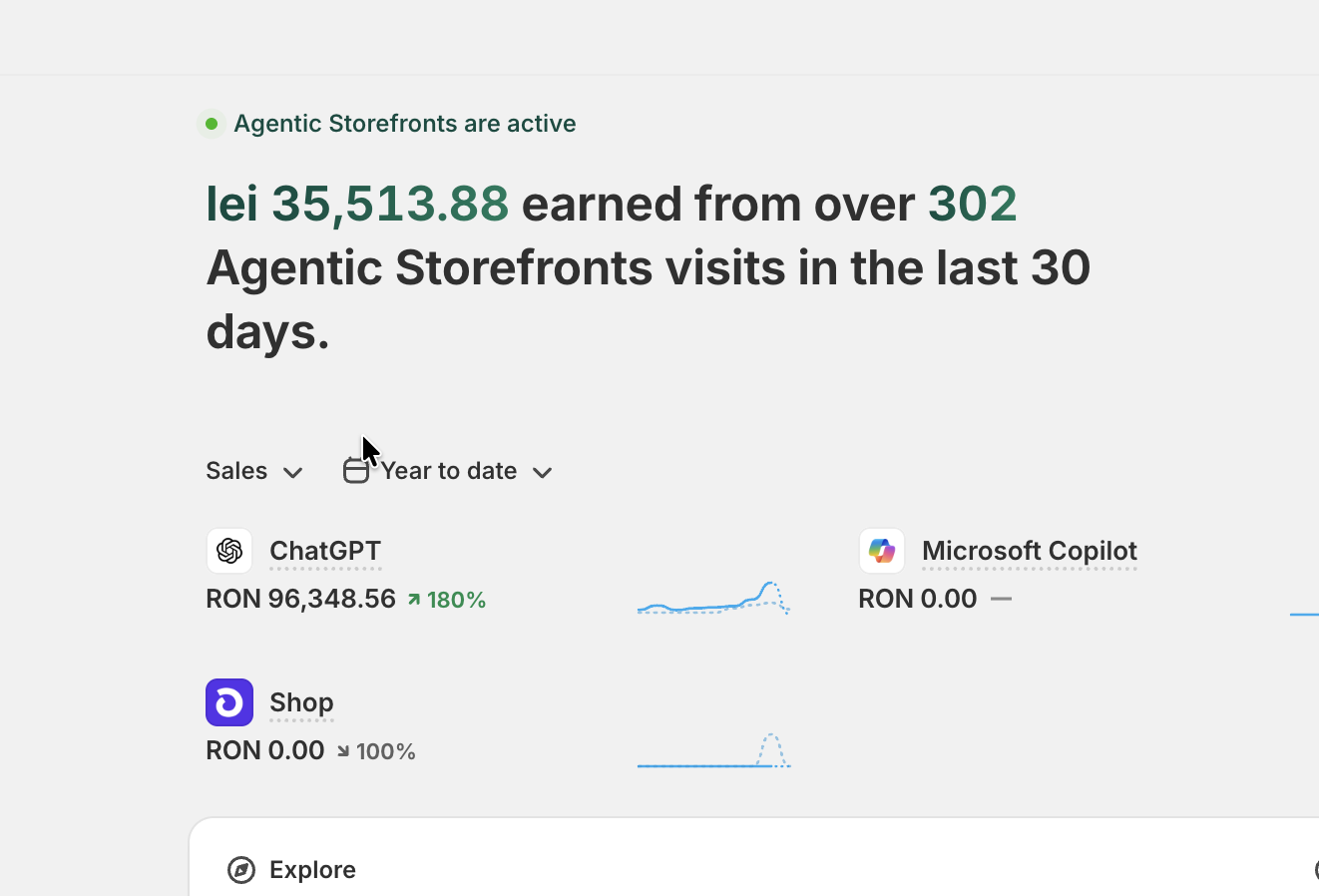
The Shopify Agentic Storefronts report screenshot supplied on 7 September 2026 shows RON 96,348.56 for ChatGPT, with the “Sales” metric and “Year to date” filter. At an indicative exchange rate of RON 5.2530 per euro, this is approximately 18,342 €.
| Metric in the screenshot | Value | Period displayed |
|---|---|---|
| Sales attributed to ChatGPT | RON 96,348.56 | Year to date |
| Agentic Storefronts summary | RON 35,513.88 | Last 30 days |
| Agentic Storefronts visits | 302 | Last 30 days |
These figures have different periods and aggregation levels. The 30-day summary is not the annual ChatGPT value and must not be added to it. The 302 visits cannot be used as the denominator for the annual result either. The comparison percentage shown in the screenshot is not used in our conclusions because its comparison period is not visible.
The source of the result is the report screenshot supplied for the study. The euro conversion is indicative, using a single exchange-rate reference, and does not represent conversion of individual transactions. ECB reference rate of 4 September 2026, published in EUR-Lex.
What SEO and GEO mean for a furniture store
SEO aims to make a store's pages findable and understandable in organic search. GEO — Generative Engine Optimization — applies the same focus on clarity and relevance to AI-based search and recommendation experiences. In this project, the two approaches meet in catalogue structure and information answering shoppers' questions.
A search such as “sofa bed” can become a much more specific question: “Which sectional sofa fits a small living room and has storage?”. To support the decision, the page needs useful product data beyond the category name.
Google states that fundamental SEO practices remain relevant to its AI features and that no special schema is required. The approach starts with accessible pages and useful content. Google documentation on AI features and websites.
1. Categories that explain product differences
The public category page analysed for this case contains explanations of L-shaped and U-shaped sofas, orientation, upholstery and storage, alongside FAQs and links to related products and categories. This information adds context to a product list and helps visitors narrow their options.
In our SEO and GEO optimisationstrategy, we start with the intent behind the search. A category addresses a general need; a product page needs to clarify the specific details of the selected model. This gives terms such as “sofa beds” and “sectional sofas with storage” a natural role in the content, without mechanical keyword repetition.
2. Product information that enables meaningful comparison
For furniture, good information lets buyers check whether a product fits their home and intended use. In store content, we prioritise clear answers about dimensions, configuration, materials, functionality and delivery.
The examples below illustrate the kind of intent we analyse. They are not actual prompts extracted from shoppers' conversations.
| Possible question | Information supporting the answer |
|---|---|
| Which sectional sofa fits a small living room? | Overall dimensions, a diagram and the space needed for extension. |
| Can I choose the chaise on the left or right? | Available orientation for the selected variant and corresponding images. |
| Which sofa also has storage? | Whether a storage compartment exists, its location and how to access it. |
| What should I know before delivery? | Lead times, delivery terms and information about access to the home. |
3. A coherent Shopify catalogue and a good mobile experience
Product discovery needs to continue into a clear purchasing journey. Our Shopify development and optimisation services connect catalogue organisation, product variants and navigation with the store's commercial objectives.
When assessing such a store, we check whether visitors understand the selected variant, find essential information and can move naturally towards ordering, including on their phones. These are optimisation priorities; the sales screenshot does not measure each one's effect separately.
Shopify recommends detailed descriptions, quality images and relevant product information for discovery in Agentic Storefronts. The catalogue and store policies must consistently communicate the available offer. Shopify guide to Agentic Storefronts.
How ChatGPT connects with Google Ads, Meta Ads and SEO
The business in this study already invests in Google and Meta advertising. We therefore analyse ChatGPT in the context of the entire marketing operation. A shopper might see an ad, search for the brand, compare models, ask an AI assistant for a recommendation and return to the site before ordering.
| Component | Role in the strategy |
|---|---|
| Google Ads | Connects the offer with demand expressed through search and campaign opportunities. |
| Meta Ads | Supports visual product discovery and returning to the offer. |
| SEO and GEO | Develops useful pages and information for search, comparison and organic discovery. |
| Content and Shopify | Clarify the offer and support the move from interest to variant selection and ordering. |
For ALLSoft Agency, the practical connection between these services is the same commercial promise supported by consistent information. The ad, category and product page must describe the offer accurately. An important question observed during sales can become a content improvement useful to visitors from other channels as well.
What the result demonstrates and how we assess ChatGPT's contribution
The report documents RON 96,348.56 in sales attributed to ChatGPT for the displayed period. This is a measurable commercial contribution during the SEO/GEO partnership and active promotion of the business. Measuring the exclusive effect of one intervention would require additional data on implementations, comparable periods and other business changes.
Measurement principle: we assess store sales separately from channel attribution. We do not add ChatGPT-, Google Ads- and Meta Ads-attributed values to produce “new” revenue, because the same orders may have multiple touchpoints.
In future assessments, useful questions include: which products and pages receive traffic from this channel, how many orders are associated with it and how do results evolve across comparable periods? Commercial interpretation must also consider cancellations, returns, margin, inventory and advertising costs.
This case shows why SEO, GEO and store performance should connect with commercial reporting. A recommendation or visit is an intermediate step; attributed sales allow analysis of the channel's participation in business results.
Frequently asked questions about SEO, GEO and ChatGPT sales
How much did ChatGPT generate for the furniture store?
The supplied Shopify report shows RON 96,348.56 in sales attributed to ChatGPT, with the “Year to date” filter, consulted on 7 September 2026. The approximate equivalent is €18,342 using the reference rate in the study.
Is the result for the last 30 days?
The RON 96,348.56 value uses the “Year to date” filter. The separate RON 35,513.88 summary and 302 Agentic Storefronts visits refer to the last 30 days. The two windows must not be confused.
Which optimisations matter for sectional sofas and sofas?
Clear categories, useful descriptions, dimensions, orientation, variants, materials and delivery terms help shoppers compare products. Technical SEO and mobile experience support access to this information and the path to ordering.
Is GEO useful if the store already uses Google Ads and Meta Ads?
Yes, it can complement the existing strategy by improving information and discoverability in AI experiences. In this case, SEO/GEO activity coexists with sustained Google and Meta advertising; channel contributions are analysed alongside store sales.
Does SEO/GEO optimisation guarantee ChatGPT recommendations?
No. Optimisation can improve accessibility and clarity of the offer, but answer selection depends on the platform and question context. The result documented here belongs to this business and the displayed period.
How does an SEO/GEO project for an online store begin?
We start with an audit of key pages, the catalogue and existing measurement. We set priorities based on search demand, missing information and purchasing obstacles, then correlate interventions with commercial changes.
Want to connect SEO and GEO with your store's results?
We analyse organic visibility, Google Ads, Meta Ads and the Shopify experience. You receive priorities for catalogue, content and measurement tailored to your business stage.
Talk to the ALLSoft team