
 Facebook Ads
 TikTok Ads
 Shopify
Custom Shopify development, directly within the existing store and theme
The client, an anonymised Romanian natural juice producer, already had a Shopify store, an active catalogue and a production theme. It needed precise interventions to turn the existing site into a better sales tool, rather than a rebuild that discarded what worked. ALLSoft Agency worked directly in the store's Shopify ecosystem: a conversion-focused homepage, rebuilt collection pages, more prominent reviews, custom product pages with bundle logic and price per litre, plus a dedicated mixed-case configurator.
A controlled extension of a live store, rather than a redesign for appearances
- Platform: Shopify, within the existing store and theme.
- Intervention: custom development, CRO, rebuilt collection pages and purchasing experience.
- Core component: a mixed-case configurator for 0.3L and 1L bottles.
- First signal: Shopify conversion rate increased from 2.70% to 2.89% across two equal 30-day windows, a relative increase of 6.8%.
- Ongoing operations: social media management, three posts per week, Meta Ads and Google Ads.
- Next stage: video content and expansion onto TikTok.
- Working principle: we develop only what has a clear commercial or operational role and keep management within Shopify.
A product that looks simple, but has many purchasing rules
The store sells several product families: juice boxes, multibox packs, bottles in different volumes and flavour combinations. Choosing needed to stay simple for customers. For the store, every selection had to reach the cart with the correct product, variant, quantity, price and SGR deposit in place.
Meanwhile, the store was already live. Any development had to integrate with the existing theme without breaking the catalogue, product descriptions, reviews or normal ordering flow. We treated the project as a controlled extension of the store, rather than a redesign purely for appearances.
We optimised the homepage within the existing Shopify theme
The homepage was reorganised to explain more quickly what the brand sells, why it is different and the main ways to buy. We brought essential commercial messages to the top of the page: natural fruit juice, pressed in Bucovina, with no added sugar, available formats and quick access to products and packs. We also built a visible route to cases prepared for home, office or events.
The work stayed within the client's Shopify theme. The live theme verified at the update date is version “Homepage CRO - 2026-08-07”, rather than a migration to a separate platform.
We turned the product page into a commercial selector
On a product in the core range (3L natural apple juice), shoppers no longer need to search separately for each pack. On the same page, they can choose one box or packs of 3, 5 or 9 boxes. The selector updates the actual Shopify option and shows, for each variant:
- total price;
- price per litre;
- number of boxes and total volume;
- availability;
- free shipping threshold;
- the product and variant that will be added to the cart.
We also preserved trust elements already important to the brand: Judge.me ratings and reviews, stock information, phone support and WhatsApp. The site now helps shoppers compare quantities and choose the right pack without navigating between several almost identical pages.
We built a custom Shopify configurator for mixed cases
The most complex component is the mixed-case configurator page. The commercial rules are clear:
- bottles of 0.3L are ordered in cases of 24 units;
- bottles of 1L are ordered in cases of 18 units;
- formats cannot be mixed in the same case;
- flavours can be combined in any proportion within the selected format;
- the cart must receive actual Shopify variants and correct quantities.
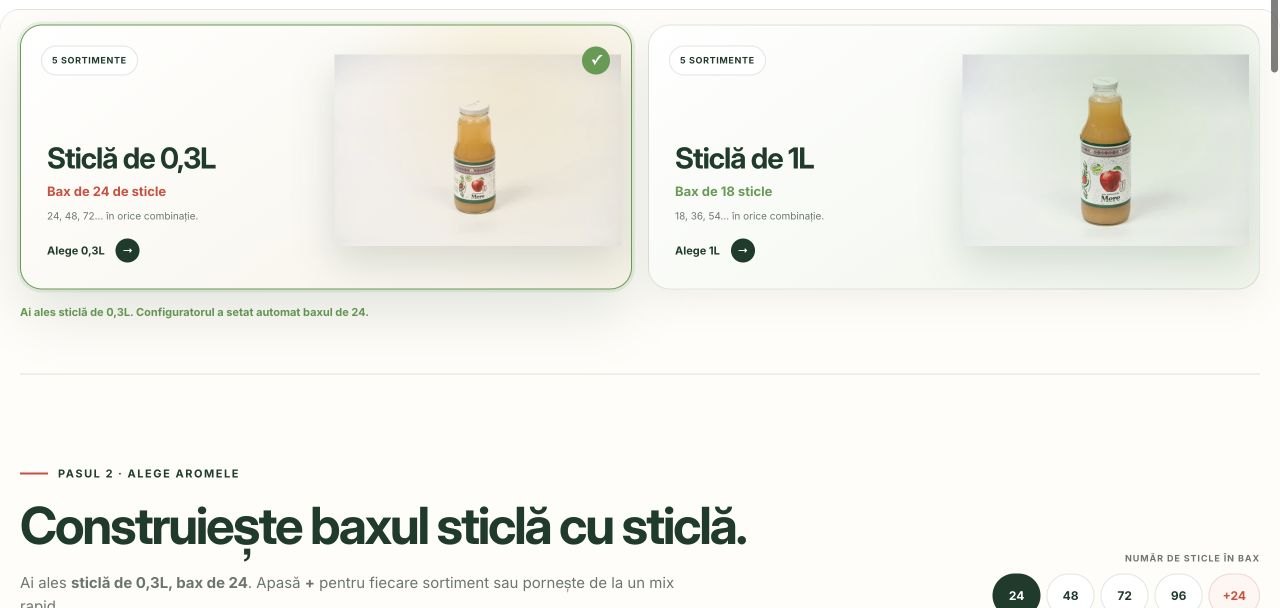
Choose your bottle
The first step automatically sets the case rule: 24 bottles for 0.3L or 18 bottles for 1L.
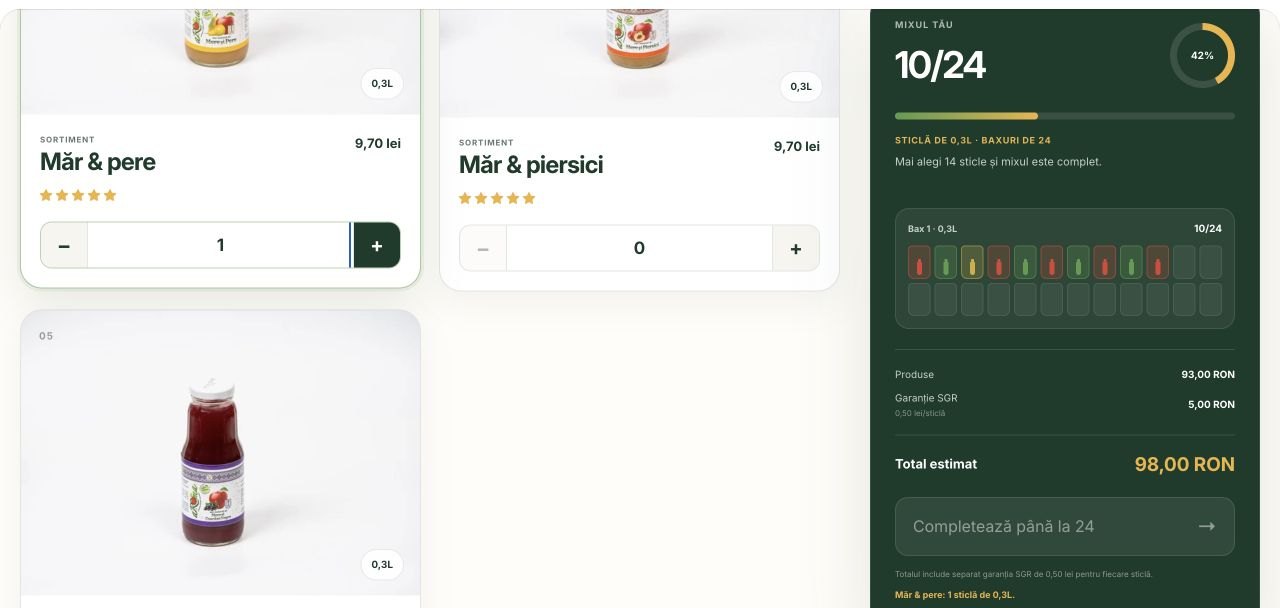
Build your case
Flavour by flavour or starting from a quick mix: a little of everything, apple only or “Surprise me”. The interface continually shows progress, case contents, product value, the RON 0.50 SGR deposit for each bottle and the estimated total.
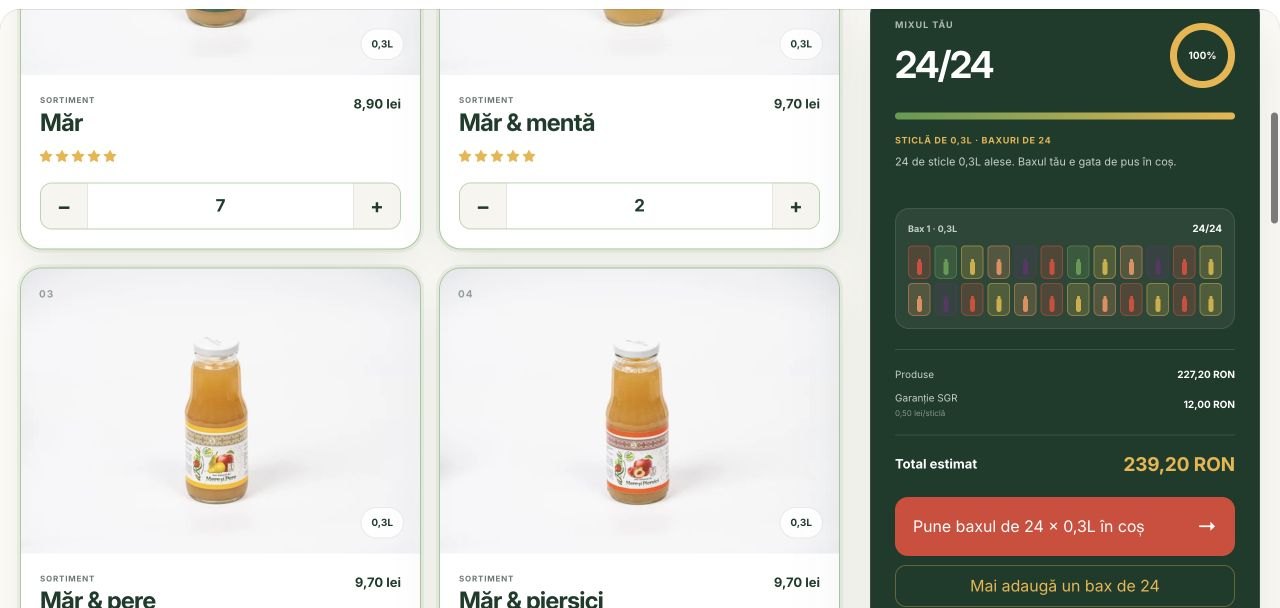
Add it to the cart
The button remains disabled until the case is complete , so an incomplete order is not passed on for manual correction.
We rebuilt collection pages and made reviews more prominent
We rebuilt collection pages for the main product families, including apple juice, aronia juice and packs. The aim went beyond visual consistency: easier choices in a catalogue with different flavours, volumes and pack types.
- a clearer hierarchy and easier-to-scan product cards;
- filtering and sorting to narrow the selection quickly;
- rating and review count moved into the visible area of the card, before users open the product;
- commercial cues such as pack details and free shipping displayed closer to the decision;
- packs presented consistently across the homepage, collections and product pages;
- recommendations for other products and quantities;
- an experience adapted for desktop and mobile.
Reviews already existed in the store's ecosystem. ALLSoft Agency's work made them more prominent in the purchasing journey, so that social proof appears while customers compare products, rather than only after opening an individual page. At the same time, all custom components use real Shopify products and variants: product identity, price and availability remain connected to the catalogue.
We worked incrementally, with QA on the real store
Because the work took place in an active store, each component was built and checked separately before integration into the live theme. We tested representative products on desktop and mobile: changing packs, updating price per litre, purchase button state, reviews, shipping threshold and adding the correct variants to the cart.
This is one of the differences between a custom Shopify project and a visual change: the result must be manageable and commercially correct, as well as look good in a screenshot.
The first signal in conversion rate
In the most recent 30-day window ending on 18 August 2026, Shopify's reported conversion rate increased from 2.70% to 2.89% compared with the preceding 30 days. The difference is +6.8% relative, or +0.18 percentage points.
This is an initial positive signal after purchasing journey improvements, including rebuilt collection pages and more prominent reviews. However, the period is short and changes were introduced gradually. For this reason, we do not present the result as a stable or exclusive effect of a single change, or confuse it with an A/B test.
What the business gained
We have an initial positive conversion-rate signal measured across two equal 30-day windows, but it is too early for a definitive attribution conclusion. Beyond this metric, we can demonstrate the functional and commercial changes delivered:
- shoppers can compare quantities and price per litre more easily;
- packs are accessible from the main product page;
- mixed cases can be configured without manually written order notes;
- incomplete orders are stopped before reaching the cart;
- products are easier to discover and compare on rebuilt collection pages;
- reviews and trust signals are visible earlier in the purchasing journey;
- the existing store was extended without migration or unnecessary catalogue rebuilding.
The long-term value is the infrastructure: a foundation for launching offers, content and campaigns without repeatedly fixing the same site friction.
Why the project continues with ongoing marketing
A better website does not create demand on its own. That is why the partnership goes beyond Shopify development. ALLSoft Agency currently manages the brand's organic communication, with three posts per week, and paid campaigns in Meta Ads and Google Ads. These channels have different roles but work within the same system:
- social media maintains brand presence and explains products;
- Meta Ads builds demand and retargets relevant audiences;
- Google Ads captures active demand;
- Shopify remains where we verify orders and commercial results.
Over the coming months, the plan includes video content production. Once there is a steady flow of assets suited to vertical formats, expansion onto TikTok becomes a natural next stage, rather than launching a channel without creative fuel. In this project, Shopify development and marketing share one commercial direction: campaigns bring demand, and the store must turn it into a clear purchasing journey.
Custom does not necessarily mean rebuilding from scratch
This project shows that custom Shopify development does not necessarily require changing platforms or rebuilding the store from scratch. When the foundation is usable, we can preserve what works and intervene exactly where the product, offer or operations need a different experience. The result is an existing store extended with rebuilt collection pages, more commercially useful product pages, pack logic and a case configurator built around real business rules.
Because development is connected to ongoing social media, Meta Ads and Google Ads activity, the website becomes the infrastructure for a long-term growth partnership.
Can custom development be done on an existing Shopify theme?
Yes. If the theme and store structure are suitable, custom components can be added incrementally. Theme dependencies, apps, the catalogue and the purchasing flow must be audited before implementation.
Does the configurator use real Shopify products?
Yes. The configurator adds the corresponding Shopify variants and selected quantities to the cart. It does not turn the case into a simple order note.
Does ALLSoft Agency only provide Shopify development?
No. In this project, Shopify development is complemented by social media management, Meta Ads and Google Ads. The next stage includes video content and launching on TikTok.
Can we start without rebuilding the entire store?
Yes. For active stores, we start by auditing the commercial journey: homepage, collection, product, cart, checkout and measurement. We then prioritise interventions that can reduce friction or support the offer.
Sources and limitations: the described features were reverified on the public store and in Shopify on 19 August 2026. Conversion rate compares two consecutive equal windows: 20 June–19 July 2026, with 3,887 sessions and 2.70% CVR, and 20 July–18 August 2026, with 3,604 sessions and 2.89% CVR. The result is presented as an early signal rather than definitive attribution because the period is short and interventions were introduced gradually. Current services and future marketing stages reflect the active partnership scope at the update date.
Already have a Shopify store, but your product needs more than the theme offers?
ALLSoft Agency can audit the existing store and build the components your business needs, without migrating just for the sake of change.