
 Facebook Ads
 TikTok Ads
 Shopify
At a glanceShopify is expanding Shop Campaigns in the European Union: you set how much you are willing to pay for a customer, and a cost arises when the campaign receives credit for a sale. But “paying per acquisition” does not automatically mean “acquiring profitably”, and as of 27 August 2026, Romania is not yet on the list of supported countries for the business address. Before setting any budget, verify actual eligibility, calculate maximum CAC from margin and separate attributed sales from sales you would have received anyway.
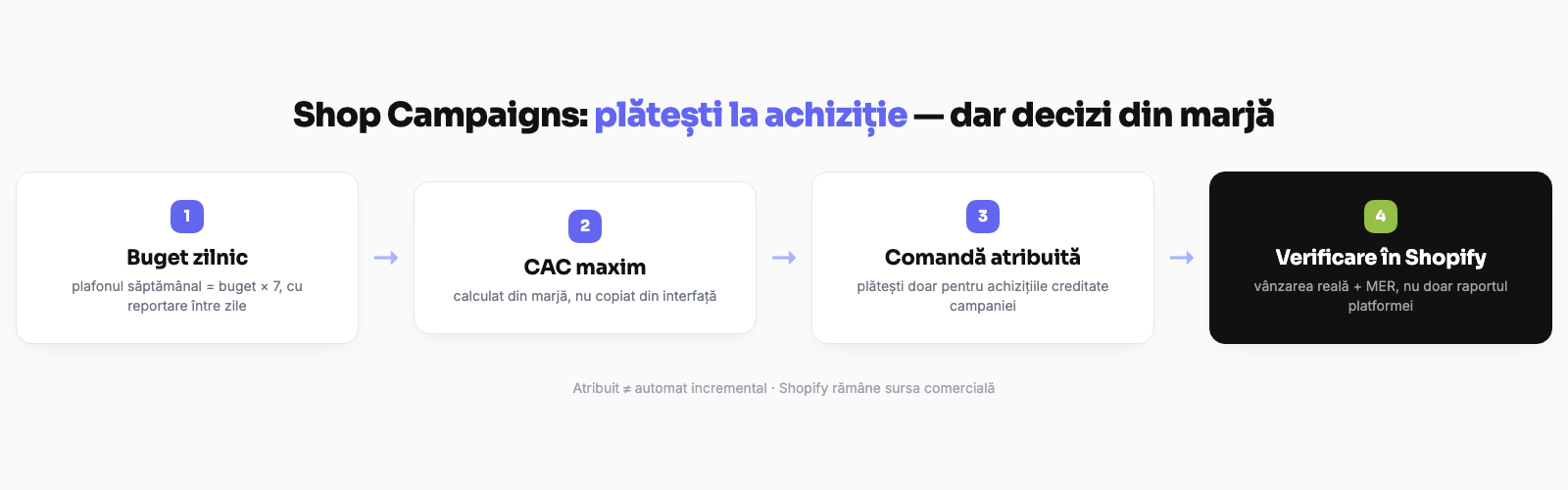
Shopify is expanding Shop Campaigns in the European Union with a model that sounds attractive to any online store: set how much you are willing to pay for a customer, and a cost arises when the campaign receives credit for a sale.
It is a significant step. But “paying per acquisition” does not automatically mean “acquiring profitably”.
Before allocating budget, answer three questions:
- 01
Is your store actually eligible?
- 02
What maximum CAC can your margin support?
- 03
How do you separate attributed sales from those you would have received anyway?
This is the difference between a controlled test and another report with good ROAS but no clear business effect.
What Shop Campaigns is and where ads can appear
Shop Campaigns is Shopify's advertising product built around acquisition cost. Merchants can choose the campaign objective, daily budget, target order value, target countries and maximum accepted cost for an attributed customer.
Campaigns appear by default in the Shop app and Shopify Product Network. Merchants can also enable distribution on other platforms. According to Shopify documentation, the list can include Facebook, Google, Instagram, Microsoft Monetize, Pinterest, Snapchat and X.
However, there is an important difference from standard campaigns:
- ads run through Shopify's accounts, rather than the store's Meta or Google accounts;
- if you enable external distribution, you do not select each platform individually;
- control is built around budget, audience and maximum CAC, rather than the detailed structure of Ads Manager or Google Ads.
For a store, this can reduce configuration work. At the same time, it provides less control over exactly which channel displays the ad.
Is Shop Campaigns available to Romanian businesses?
As of 27 August 2026, Shopify's public documentation does not include Romania in the list of supported countries for the address of a business using Shop Campaigns.
The list includes several European countries, including Austria, Belgium, Bulgaria, Croatia, France, Germany, Greece, Italy, the Netherlands, Portugal, Slovenia and Spain. Shopify announcing an EU rollout does not automatically mean every company registered in an EU country has immediate access.
Two things need to be distinguished:
- the country where the company is registered;
- the markets where the campaign can target shoppers.
The decisive check is in the store, under Sales channels → Shop → Advertising. The eligibility banner and campaign creation option are more relevant than a general email or product announcement.
If access is missing, do not build a budget and forecast as though the feature were already available. Shopify is expanding the product gradually, and conditions may change.
Shopify's eligibility requirements
Alongside a business address in a supported country, Shopify currently lists several conditions:
- at least one active market in a supported country;
- Shopify Payments configured and able to accept AUD, CAD, EUR, GBP or USD;
- direct selling in Shop and direct checkout enabled;
- Shopify Network Intelligence enabled;
- a valid payment method for Shopify invoices;
- a store without password protection;
- compliance with Shopify, Shop and advertising partner policies.
Eligibility is not checked only once. Shopify reassesses the store, and a compliance issue can prevent new campaigns from launching or suspend active campaigns.
Paying per acquisition does not eliminate commercial risk
Shopify communicates a clear benefit: merchants pay for purchases attributed to the campaign and are not charged above the maximum CAC set for that segment.
This reduces the risk of paying only for impressions or clicks without any attributed order. It does not automatically fix order economics.
A customer acquired for RON 80 is neither good nor bad in absolute terms. It is good if the store's margin can support RON 80 and leave enough profit after all variable costs. It is bad if the order value looks good but the product has low margin, subsidised shipping, a high return rate or high operational costs.
Working formulaMaximum CAC = net order revenue − product cost − payment processing − delivery costs borne by the store − variable operating costs − estimated returns − minimum desired profit
Do not start from the interface recommendation or copy another store's CAC. Two stores with the same average order value can have completely different margins.
How the budget works
Shop Campaigns uses a daily budget. According to Shopify, the unspent portion of one day can carry over to later days in the same week.
This means spend will not necessarily be identical each day. One day can spend less and another more without the total exceeding the weekly cap of daily budget multiplied by seven.
For analysis, avoid drawing conclusions from a single day. Use a complete window and compare:
- the configured budget;
- actual spend;
- attributed customers and orders;
- order value;
- actual CAC;
- total store sales;
- total media spend and MER.
Attributed does not automatically mean incremental
This is the part many reports skip.
Shopify can attribute an order to Shop Campaigns when an eligible customer uses an offer or buys after seeing a campaign ad. The order is real, but attribution does not automatically prove the sale would not have happened without the campaign.
The same risk exists in Meta and Google Ads. The platform reports contribution according to its own rules and attribution windows. The business needs to check whether the overall result changes.
An important example is brand search. Shop Campaigns can bid on terms containing the store's name. This option is off by default but can be enabled.
Brand searches can produce very good ROAS because users already know the store. This does not mean they should automatically be stopped. It means brand results and acquisition of new demand need separate analysis.
We do not add Shop Campaigns-, Meta- and Google-attributed sales as though they were different revenues. The same order can receive credit in multiple systems.
Shopify remains the commercial source of truth. Advertising platforms provide diagnostic data for budget allocation.
Five checks before the first test
- 01Confirm access in Shopify Admin
Do not assume eligibility just because you received an email. Check Advertising in the Shop channel and any compliance notifications.
- 02Calculate maximum CAC from margin
Use actual product data, shipping costs, processing fees, returns and minimum desired profit. Without this figure, you do not yet have a safe campaign cap.
- 03Check the shopping experience in Shop
Products, prices, stock, images, policies and direct checkout must be correct. A pay-per-acquisition model does not fix a weak catalogue or confusing experience.
- 04Decide how to handle brand
Document whether brand-search bidding is active. Otherwise, you may interpret capture of existing demand as entirely new acquisition.
- 05Set success criteria in advance
Define before launch: maximum accepted CAC, minimum margin, test period, maximum budget, stop threshold and how to reconcile results with Shopify and MER.
When Shop Campaigns is worth testing
A test makes sense if the store is eligible, tracking is coherent, margin can support a realistic CAC and the catalogue is ready for Shop.
It may be especially interesting when you want to:
- reach shoppers in Shop and Shopify Product Network;
- test customer acquisition or reactivation;
- expand distribution without building each external campaign separately;
- set a clear cost-per-customer cap;
- compare a new channel with the store's overall commercial results.
It is not worth launching simply because it is a new feature or “paying per conversion” sounds risk-free.
If you do not know contribution margin, have duplicate tracking, the feed does not reflect stock or total sales cannot be reconciled, fix the foundations first.
A new channel does not replace strategy
Shop Campaigns adds a serious option to the Shopify ecosystem. It shifts some risk from clicks to acquisitions and simplifies access to several advertising surfaces.
But the commercial rule stays the same: we do not optimise from a single interface or confuse attribution with profit.
At ALLSoft Agency, we analyse the store, tracking and advertising channels together, from Shopify store development to Meta Ads campaigns and Google Ads. We verify actual sales in Shopify, use platform ROAS for diagnosis and compare total spend with actual revenue through MER.
To find out what CAC your store can support and whether Shop Campaigns belongs in your mix, request a Shopify analysis. We tell you directly what is ready, what needs fixing and what cannot yet be demonstrated.
Official sources for verification
- Shop Campaigns — requirements and eligibility
- Shop Campaigns — channels, targeting and budgets
- Shop Campaigns — attribution and billing
Availability and eligibility information was verified on 27 August 2026 and may change as Shopify expands the product.